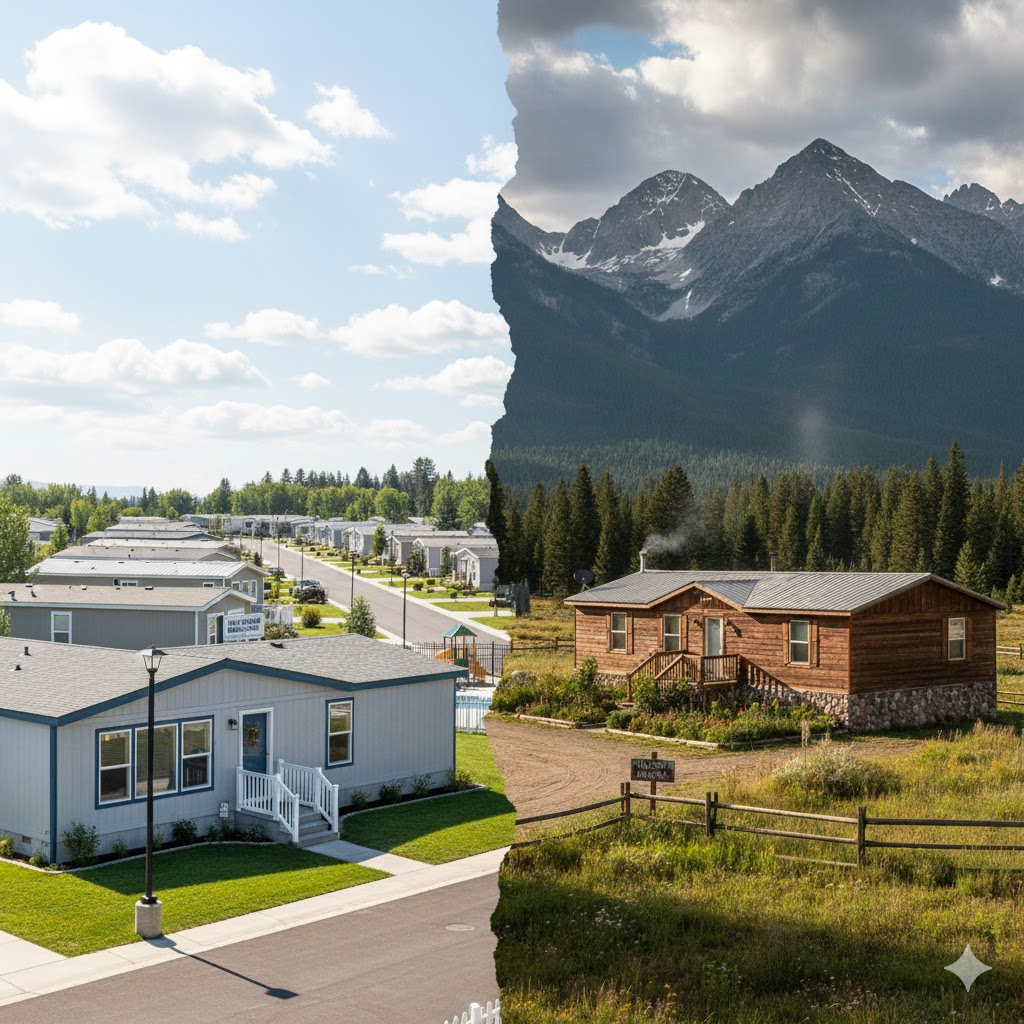
Manufactured home communities (also known as parks or land-lease communities) play a massive role in providing affordable, stable housing across the United States.
But if you’ve never lived in one, the process can feel confusing:
- How does lot rent work?
- What’s the difference between an all-age park and a 55+ community?
- What rules do residents follow?
- What are you responsible for vs. the community?
- How does community approval work?
- What affects your monthly cost?
- Are some communities better for resale?
This guide answers all of that — clearly and honestly.
By the end, you will fully understand how manufactured home communities operate and how to choose the best one for your lifestyle and budget.
SECTION 1 — WHAT IS A MANUFACTURED HOME COMMUNITY?
A manufactured home community is a neighborhood where:
- You own the home, and
- You rent the land it sits on
This arrangement is called land-lease.
What the community provides:
- the land
- maintenance of common areas
- parking areas
- roads
- utilities (varies)
- landscaping (varies)
- community amenities
- management and operations
What you own:
- the home itself
- upgrades you make to the home
- your equity
- your personal yard space
SECTION 2 — TYPES OF MANUFACTURED HOME COMMUNITIES
There are four main types in the United States:
1. All-Ages Communities
The most common type.
Ideal for:
- families
- singles
- first-time buyers
- retirees
- multi-generational households
Typical features:
- playgrounds
- dog parks
- walking paths
- parking areas
- community centers
These tend to have lower rents compared to 55+ communities with premium amenities.
2. 55+ Active Adult Communities
Age-restricted neighborhoods.
Requirements:
- at least one resident must be 55+
- all other residents typically must be 18+
Lifestyle features:
- quiet
- low crime
- resort-style amenities
- clubhouses
- pool/spa
- social events
- fitness centers
These communities are extremely popular for retirees.
3. Resident-Owned Communities (ROCs)
The residents collectively own the land.
This means:
- no landlord
- stable lot rent
- voting rights
- long-term affordability
ROCs often have the best long-term value and community stability.
4. Luxury / Premium MH Communities
These are modern, high-end MH neighborhoods with:
- gated entrances
- resort-level landscaping
- pools
- saunas
- fitness centers
- event programming
- modern homes
Often found in CA, AZ, NV, TX, FL, CO.
SECTION 3 — HOW LOT RENT WORKS
Lot rent is a monthly fee paid to the community for:
- the land
- trash service (varies)
- sewer/water (sometimes)
- community maintenance
- amenities
- management teams
- roads and infrastructure
- snow removal (cold states)
- landscaping (varies)
National average lot rent (2025):
$550–$900 per month, depending on state and amenities.
What lot rent does NOT include:
- loan payment
- home insurance
- electricity (most communities)
- gas
- internet/cable
Lot rent is usually recalculated yearly.
SECTION 4 — APPLICATION & APPROVAL PROCESS
Before you can move into most communities, you must be approved.
Communities typically require:
✔ Background check
Looking for:
- felonies
- serious offenses
- violent crimes
- drug-related crimes
✔ Credit check
They want to see your history with payments and obligations.
Perfect credit is NOT required.
✔ Income verification
You must show you can afford:
- lot rent
- loan payment
- utilities
✔ Identification
Valid ID and sometimes SSN verification.
✔ Rental history
Shows your payment reliability.
Approval protects the safety and quality of the community.
SECTION 5 — RULES & REGULATIONS
Manufactured home communities are known for having clear rules that maintain order.
Here are the most common ones:
✔ Pet rules
- number of pets
- breed restrictions (varies)
- leash requirements
✔ Parking rules
- number of vehicles
- street parking restrictions
- RV/boat storage rules
✔ Home appearance
- skirting requirements
- paint rules
- cleanliness expectations
✔ Noise
- quiet hours
- behavioral expectations
✔ Yard maintenance
Residents must maintain their own yard.
✔ Guest rules
Communities may limit long-term guests.
✔ Add-ons & modifications
Decks, porches, awnings, and sheds often require approval.
These rules protect community value and safety.
SECTION 6 — WHAT MAKES A COMMUNITY “GOOD”?
A high-quality community has:
1. Strong management
Responsive, friendly, and consistent.
2. Cleanliness
Well-maintained common areas.
3. Safety
Lighting, security, low crime.
4. Stable lot rent
Reasonable increases.
5. Good resident satisfaction
Low turnover.
6. Good resale value
Homes sell faster and higher.
7. Fair rules
Clear and consistently enforced.
Communities with these traits perform better long-term.
SECTION 7 — WHAT MAKES A COMMUNITY “BAD”?
Warning signs include:
❌ Frequent management changes
❌ Poor maintenance
❌ High crime or unsafe environment
❌ Unstable lot rent increases
❌ Poor communication
❌ Visible abandoned homes
❌ Inconsistent rule enforcement
❌ Trash or debris buildup
These factors can impact quality of life AND resale value.
SECTION 8 — AMENITIES FOUND IN COMMUNITIES
Amenities vary widely.
Common:
- playgrounds
- dog parks
- basketball courts
- picnic areas
- community hall
Higher-end:
- pools
- hot tubs
- fitness centers
- gated entry
- security patrol
- event programming
Amenities can affect lot rent.
SECTION 9 — COSTS OF LIVING IN A COMMUNITY
Monthly cost includes:
✔ Lot rent
$550–$900 typical.
✔ Home loan payment
Varies by home price and lender.
✔ Home insurance
$80–$120 monthly.
✔ Utilities
Electric, gas, water, sewer, trash (varies).
✔ Maintenance
Home upkeep, small repairs.
✔ Optional fees
Pet fees
Amenity fees
Application fees
Storage fees
LotRoll’s listing pages clearly show lot rent and rules so buyers know upfront.
SECTION 10 — HOW COMMUNITIES AFFECT RESALE VALUE
Your resale value is influenced by:
✔ location
✔ community cleanliness
✔ amenities
✔ management quality
✔ lot rent price
✔ stability of rules
✔ buyer approval process
✔ competition in the park
Homes in well-run communities sell MUCH faster.
SECTION 11 — HOW LOTROLL HELPS BUYERS & OWNERS
LotRoll provides:
✔ Community-level data
Lot rent
Amenities
Approval requirements
Rules
Pet policies
Age restrictions
✔ Buyer tools
Financing
Insurance
Valuation
QR-code listing pages
✔ Clarity
No surprises — all info is available upfront.
✔ Confidence
Owners know what they’re getting into.
Buyers know if they’ll be approved before applying.
This is how modern manufactured home buying SHOULD work.
CONCLUSION
Manufactured home communities can offer:
- safety
- affordability
- community
- stability
- amenities
- and long-term value
But only when you choose the right one.
LotRoll gives you the information you need to make that decision confidently.
Explore communities, lot rent, rules, and approval requirements at LotRoll.com.
Know everything before you move in.