How to Finance a Manufactured Home and Land: Chattel, Real Property, MH Advantage, and CHOICEHome Explained
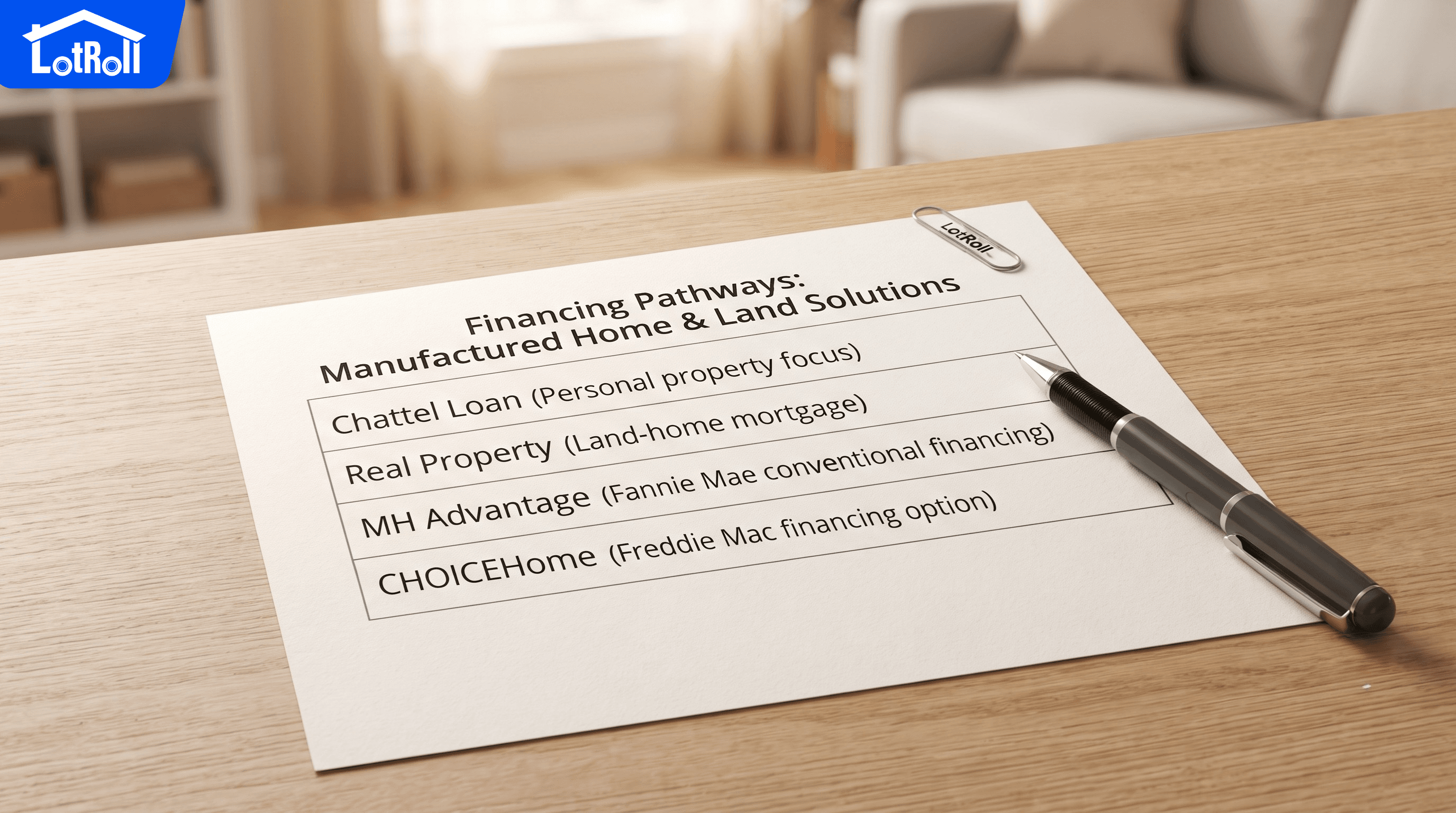
Buying a manufactured home and land can be confusing because the financing depends on one major question: Will the home remain personal property, or will it become part of the real estate? That distinction affects the loan type, interest rate, down payment, appraisal, title process, and whether programs such as Fannie Mae’s MH Advantage® or Freddie Mac’s CHOICEHome® are available.
The Three Main Financing Paths
1. Construction to Permanent Land Home Financing
A construction-to-permanent loan refers to a financing option that offers buyers a combined loan that combines financing for the property lot, construction, and the mortgage. This loan type automatically transitions throughout the building process, and offers buyers flexible down payments and low interest rates, while they’re able to finance the delivery and construction of the home and the mortgage without taking out separate loans. This tends to be the best option for buyers who are purchasing the manufactured home, the land, delivery & setup, utility connections, and foundation work.
2. FHA Title I or Chattel Loans
Both these loans are financing options open to buyers whose homes are titled as personal property. However, while FHA loans finance the home and the lot, chattel loans finance only the home. These loans are most common for homes on leased land, homes not affixed to land, or when the homeowner does not own the lot. Generally, these loans are harder to come by due to the fact that not many lenders offer them, and they often have higher interest rates than traditional loans. Despite the higher costs, chattel loans remain one of the most common financing types for manufactured homes in land lease communities.
3. Separate Land and Home Loans
A buyer may also use two separate loans to finance the land and the home. A chattel loan can be taken out to finance the home, and a land loan can be taken out for the property. These loans are tricky, however, because they open the door for potential conflicts between different lenders, as well as putting the buyer in a position to make two separate payments each month.
Find a more detailed guide here: Financing Comparison Guide.pdf
How Does a Manufactured Home Become Real Property?
A manufactured home, even a HUD-certified one, does not automatically become titled as real property just because it is placed on land. The conversion from personal to real property generally requires three pillars:
- A Legal Site
The property must comply with local zoning and land use laws. These laws can dictate home aspects like home or lot size, septic and sewer standards, HOA and subdivision requirements, foundation standards, building materials, roofing rules, or utility access. Local regulations tend to vary by location, and early zoning verification is important.
- A Permanent and Permitted Installation
Homes must generally be installed on a permanent and pre-approved foundation to be considered real property. Permitted foundation types commonly include concrete slab foundations, basement foundations, crawlspace foundations, and HUD approved pier-and-beam systems. Owners may need to obtain additional permits for plumbing and septic systems, gas, water and electric, or any add-ons like decks, porches, or garages. Homes must pass local inspections, and the foundation must comply with both HUD standards as well as local building codes.
- Legal Title Conversion
Manufactured home titles typically must be surrendered, or otherwise legally joined to the land the home lies on. The exact process is dependent on state and local laws, but they generally include an affidavit of affixation, a title surrender application, a lien release, the home’s serial number and land’s legal description, proof of permanent installation, and recorded documents connecting the home to the parcel. Placing the home on a concrete foundation alone is not enough, and the legal process is crucial to how the title is changed. Once converted to real property, the home is now legally a permanent part of the land, and is now transferred through a deed instead of a separate title certificate. This title conversion is what allows for buyers to qualify for traditional mortgage financing.
What Are MH Advantage and CHOICEHome?
Fannie Mae’s MH Advantage® and Freddie Mac’s CHOICEHome® are conventional mortgage programs for qualifying manufactured homes with enhanced design and installation standards, rather than chattel loan programs. Qualifying homes must be built in accordance to HUD codes, permanently installed onto a foundation, titled as real property, and certified with an MH Advantage sticker or CHOICEHome label. Buyers who are eligible for these loans can receive down payments as low as 3%, long-term conventional mortgage financing, enhanced appraisal treatment, reduced manufactured-housing pricing adjustments, or financing terms closer to site-built housing. These programs were both developed by government sponsored enterprises (GSEs), in order to grow and expand access to affordable homes, in an understanding the newly built manufactured homes will look closely to and perform similarly to traditionally built homes.
What Makes These Homes Different?
These homes, unlike other manufactured properties, are specifically designed to look more like traditional homes, so they often include features that sets them apart in this sector of the market. They may be required to include things like an approved foundation system, a garage, carport, or permanent driveway, enhanced siding and finishes, a residential roof pitch or covered porch, or improved energy efficiency and permanent utility connections. Exact home property requirements and specifications may vary based on home design, manufacture date, and current program rules.
Who Builds MH Advantage and CHOICEHome Homes?
Several major companies nationwide participate in these programs, including but not limited to, Clayton Homes, Cavco Industries, Fleetwood Homes, Palm Harbor Homes, Skyline Champion, Champion Home Builders, Adventure Homes, Deer Valley Homebuilders, Oak Creek Homes, KIT Custom Homebuilders, Franklin Homes, and Sunshine Homes. However, not every home these companies build qualify for these programs, and the eligibility can depend on the home’s manufacturing plant, model and floor plan, buyer’s purchase order, home’s manufacture date, and completed site improvements. Buyers should pre approve in writing that the specific property will receive an MH Advantage sticker or CHOICEHome label before placing a nonrefundable order.
What Buyers Should Confirm Before Ordering a Home
Before going through with a home purchase, buyers should confirm:
- Whether the home will remain chattel or become real property
- Whether local zoning allows the home
- Whether the lender finances the home, land, and installation together
- Whether the foundation and site work meet lender requirements
- Whether the home must carry an MH Advantage or CHOICEHome certification
- Whether the title can be converted under state law
- Whether existing liens will be released
- Whether all required permits and inspections can be completed
The Bottom Line
Manufactured homes can be financed in several different ways, but the correct structure depends on how the home and land will be owned and titled. Homes classified under personal property will generally use chattel or FHA Title I financing, while a home that is permanently installed and converted to real property may qualify for conventional, FHA, VA, USDA, MH Advantage, or CHOICEHome financing. The best time to determine the financing structure is before the buyer orders the home, purchases the land, or begins site work.