How the 21st Century ROAD to Housing Act will Revolutionize Manufactured Housing
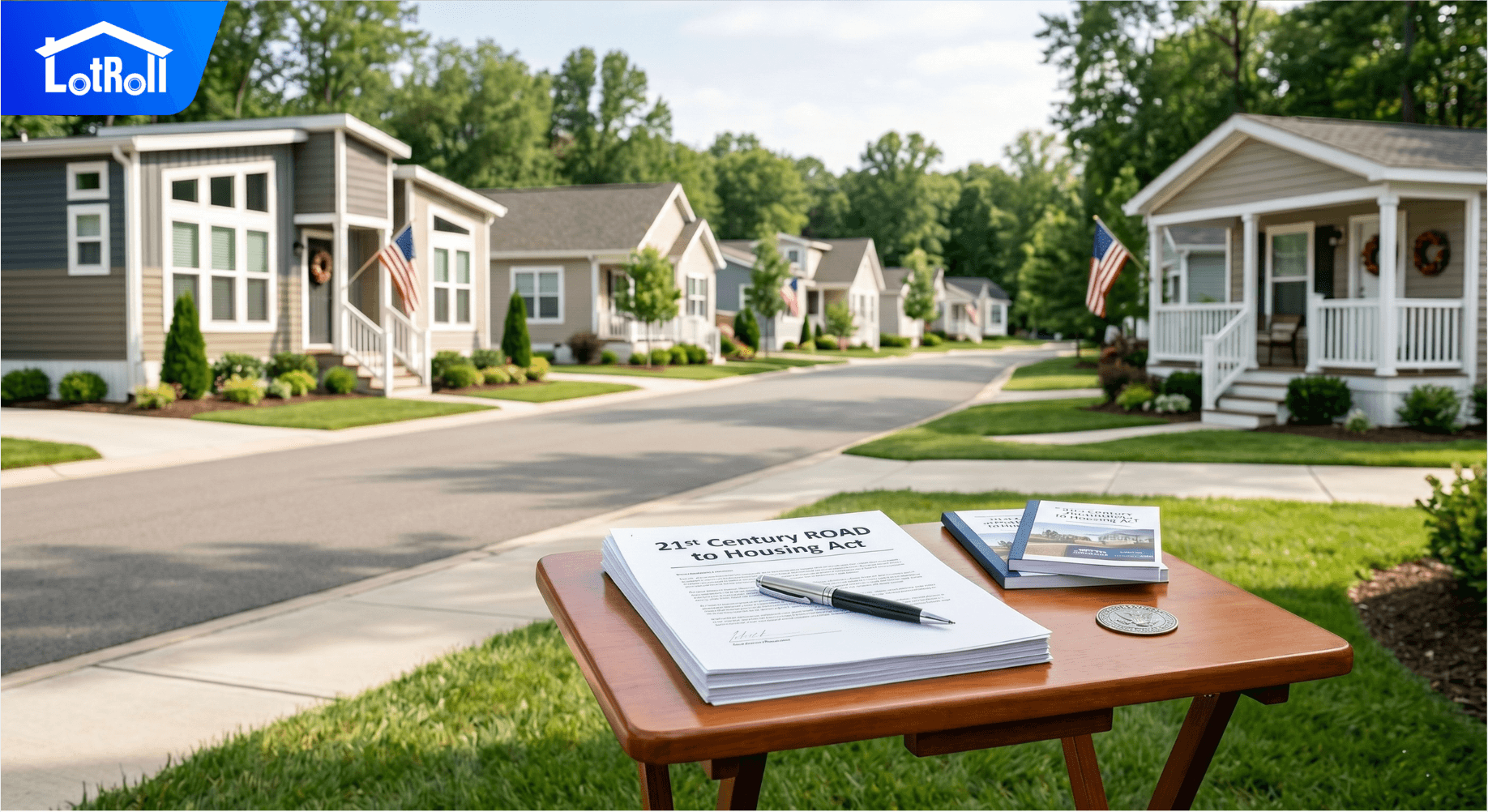
The passing of the 21st Century ROAD to Housing Act aims to modernize federal housing regulations, improve affordability, supplement more financing options, and increase overall supply. The bill combines all of these different proposals into one package designed to support homebuyers and sellers alike, by making the process more federally efficient.
This bill holds major implications for the manufactured housing industry especially, signaling that the government may finally be recognizing the legitimacy of the market as a solution to the country’s housing shortage and affordability crisis.
LotRoll has long believed that manufactured housing is not just a niche market, but rather a practical and affordable solution to housing issues. The passing of this bill is one of the most revolutionary in recent history, as it has potential to reshape the entire industry. Beyond just affordability, the act can change the standards for loans, appraisals, and zoning moving forward.
Why Manufactured Housing Matters Now More than Ever
America is currently experiencing a serious housing shortage, with a lot of competition for available units. Even as population growth increases, underbuilding persists, leading to a substantial gap between the amount of available homes vs the number of those looking, and there are estimated to be millions more people in search of a home to buy than buildings that actually exist. Additionally, prices of homes have surpassed income in many areas, and first time homebuyers are often unable to make down payments or qualify for mortgage loans.
The cost of construction has also gone up substantially, as has the price of materials, land, and insurance in recent years, making it difficult for builders to create on-site homes at an affordable price. This coupled with the fact that there are fewer construction workers now than there used to be slows the process of home building significantly, and the lack of labor capacity makes it nearly impossible to build enough homes to meet the demand.
Manufactured Housing Presents a New Opportunity
Manufactured housing can serve as a serious solution to many of these issues. These homes cost, on average, much less to construct per square foot, and the fact that they’re able to be built in factories leads to lower manufacturing and labor costs. Manufactured homes provide one of the few remaining pathways for first time buyers to purchase a home affordably. These home sales account for a larger sector of the market than most people realize, and each year there are hundreds of thousands of sales through various different avenues. Many home sales take place outside of traditional real estate channels, through things like DMV transfers, private sales, retailers, or community sales.
Millions of Americans already reside in these homes, scattered through urban, suburban, and rural communities, accounting for almost 9% of all home sales each year. However, since the industry largely operates outside of traditional realms, there is a severe lack of transparent and accessible data, creating challenges for buyers, sellers, and industry professionals alike.
Challenges to the Industry
Manufactured housing faces several setbacks during sales that traditional homes do not. There are zoning and finance issues, as well as data fragmentation that poses serious selling challenges. Many manufactured homes do not receive traditional mortgage loans, but instead chattel lending, which refers to a loan in which someone’s personal property serves as collateral. While this financial agreement can be helpful for buyers, they do not carry the same weight as traditional morgan loans and often run into problems. The limited market support can also increase costs. Additionally, zoning restrictions often work against the construction of manufactured homes. There are several regulations that limit where these homes can be built, which ultimately leads to a reduction in consumer demand.
The lack of data transparency in the industry also creates lots of issues, for buyers and sellers alike. Sales data is often dispersed across different channels, and the market lacks consistency in data reporting, making evaluation, market analysis, and investing more difficult. Appraisers also lack transaction data about comparable sales, leading to difficulty in lending decisions and declaring home pricing and value. State and federal regulations have not caught up to this growing market, and there has been a big push by industry leaders in recent years for modernization.
What is the 21st Century ROAD to Housing Act?
Legislators from both sides of the aisle worked to develop this bill in order to face the nation’s housing shortage, incorporating proposals from both parties to increase the market and develop more housing opportunities, while decreasing barriers. Policymakers feel increased supply is a key way to expand affordable housing options. The bill poses updates to federal policies on housing, regulations, and financing, including several articles and provisions pertaining specifically to manufactured housing development, aiming to upgrade financing and get rid of challenges that stand in the way of increasing housing production.
Currently, the bill has passed the House and is currently being reviewed in the Senate, where the two are waiting to work out differences in their final drafts. The legislation will then move to the executive branch, where professionals in the industry wait for its final approval.
Expanding the Definition of Manufactured Housing
Historically, manufactured homes were required to be built in accordance with HUD code, and built on a permanent chassis, which is a large steel frame, and comes from rules and regulations based on mobile and trailer homes. Today, though, this standard creates limitations for builders and decreases design flexibility. In zones where communities prefer more traditional home foundations, it can bar out manufactured homes completely. The housing act would allow for homes to be built without this foundation, and they could instead be built in factories while still complying with local and federal standards. The removal of the chassis rule would mean that these homes could become much more easily integrated into more traditional neighborhoods, with the distinctions between on-site and manufactured homes becoming nearly imperceptible.
The removal of these regulations would also grant builders more freedom, allowing them to build houses in different styles with lowered regulation costs, and ones that could better match local market demands.
Modernizing Manufactured Housing Financing
Financing challenges are one of the biggest setbacks that manufactured housing faces, and, traditionally speaking, many mortgage lenders do not want to get involved in the market due to high fiscal risk. Buyers tend to face higher borrowing rates than traditional homebuyers, often because there is not a comprehensive set of data for appraisers to compare pricing against. Additionally, financing options are severely limited for homes that are not attached to owned and sold land.
The new legislature would change this framework by improving mortgage access for manufactured home buyers, and the federal support of the industry would encourage lenders to participate on a broader scale as they have more trust and federal protections. Modernizing these programs will help the buying process become more accessible to first-timers, and those with low to moderate income.
Standardizing this process would benefit not only buyers, but lenders and sellers as well. As more lenders enter the market, competition in sales increases giving consumers more choices and as financing becomes easier, sales will in turn increase. Buyers will encounter fewer obstacles overall, and they will have more options for finances, creating a much larger segment of affordable homes.
Appraisal and Evaluation Improvement
There are several issues with appraisal and valuation in the manufactured home industry that the bill aims to improve. One of the major problems is that there is a lack of comparable sales data. Many transactions occur outside of traditional systems, meaning that appraisers often have limited access to data. Additionally, valuation is done differently by different parties, and manufactured homes are typically evaluated differently than onsite houses. The fragmented data of sales and the limited transparency creates inconsistency in valuations.
The bill aims to modernize and unify valuations industry wide, encouraging appraisers to consider things like market demand, location, and home quality, giving both appraisers and lenders better and consistent standards to work from. This would create many industry wide benefits, including more accurate valuations as the data available increases, and value based on market performance rather than guesswork. Both buyers and sellers will benefit from fairer pricing, and appraisal delays will be reduced. Loan approvals could also move faster, as reliable and accurate valuations lead to lender confidence and reduce risk and uncertainty, as lenders become more willing to back manufactured housing.
Housing Supply Expansion
Entry level home purchase has become increasingly challenging, as buyers navigate both a housing shortage and prices that are skyrocketing. Affordable homes are scarce, in both rural and urban environments, and the properties are disappearing faster than they are being replaced.
This is where manufactured housing comes in, as they can be built much more quickly and affordably than traditional homes, offering solutions to the problem on multiple fronts. The manufactured market can actually keep up with consumer demand, and the factory construction environment provides consistent timelines and uniform quality. As market demand drives up, manufactured home construction can match it, and greatly expand affordable options for first time buyers, especially as policymakers embrace manufactured housing as a mainstream solution.
Industry Stakeholder Implications
● More housing choices
● Lower borrowing costs and more financial backing options
● Both affordability and accessibility increased
● Better risk assessment and collateral evaluation
● Access to a larger borrowing base
● Loan variations
● Growing market
● Improved data transparency and better infrastructure
● Better financing and valuation systems
● More transactions market-wide
● Access to better and more transparent client data
● More market visibility, and transparency and listings and pricing
● Stronger demand for manufactured housing options
● More buyers and long term occupants
More financing options and solutions for prospective customers
Importance of Data Infrastructure
Similarly to how the traditional home market relies on MLS systems, manufactured housing will need its own reliable and comprehensive database to support market growth at this scale. The industry will need records of ownership and title data, occupancy data, modernized valuation and appraisal tools, financing and lender insights, comprehensive home data, greater transaction transparency, etc. This is where LotRoll comes in, as they are one of the first to provide this infrastructure, along with some MLS systems, helping to encourage efficiency and transparency in this growing sector of the market. LotRoll aims to partner with existing MLS infrastructure and with MLS systems who wish to bring this forward. The mission is to bring manufactured housing to the same level of professionalism as traditional housing.
Looking Ahead
While it may offer many advancements and progress, the 21st Century ROAD to Housing Act is not a complete magic fix to America’s housing crisis. It does, however, signify one of the important turning points in policymakers recognizing the importance and validity of manufactured housing as a critical solution in the future of affordable housing. By improving upon outdated policies, expanding supply, and supporting appraisal reform, just to name a few, the legislature could potentially accelerate the industry’s transition from a niche into the mainstream. For a sector that already houses millions of Americans but has been generally overlooked, the shift could supply many new housing opportunities for the entire market.
Manufactured housing has always served as one of the most powerful tools in affordable housing, the question has never been if manufactured housing is the answer, but rather policy would evolve to support it. The 21st Century ROAD to Housing Act gives us a signal that this may finally be happening.